Our Blogs
Blogs
/
Blog Details
Comments
No Comments
Author
MediaZen
Post Date
September 4, 2026
Getting SEO Value From Press Releases



"Explore the significance of digital marketing in today’s business landscape and discover effective strategies and powerful tools to enhance your online presence & engage your target audience."
- Adamson Janny
Press releases have had a strange relationship with SEO over the years. Once treated as a straightforward link-building shortcut, they’ve been through enough algorithm changes that it’s fair to ask whether they still pull any weight today.
They do, just not in the way most people assume.
A Brief History of Press Releases in SEO
Press releases have been part of the marketing toolkit for decades, but their role in SEO has shifted considerably.
Before 2012, online press releases were a go-to link-building tactic. Companies pushed out releases constantly, often stuffed with keywords and links, chasing higher rankings with volume rather than substance. It worked for a while, mostly because there wasn’t much scrutiny on how those links were earned.
That changed with Google’s Penguin update in 2012, which shifted the emphasis from the quantity of links a site had to the quality behind them. Google’s own John Mueller later addressed press releases directly, noting that Google tends to discount links from releases since companies typically publish them about themselves rather than earn them through independent coverage.
That doesn’t mean press releases became worthless. Plenty of SEO practitioners still find real value in using them strategically, just not as a link-farming shortcut.
Google added another layer in 2019 with the “nofollow,” “sponsored,” and “UGC” link attributes, pushing the emphasis further toward content quality and relevance. The shift was clear: it was never really about how many links you could cram in, it was about whether the content itself was worth publishing.

Does Press Release SEO Still Work Today
Yes, but not in the way it used to.
If the goal is to churn out keyword-stuffed releases and expect a ranking boost, that approach stopped working years ago. What still holds up is using press releases as part of a longer-term strategy, building brand visibility, credibility, and occasionally earning genuine backlinks from outlets that choose to cover the story on its own merits.
Here’s where that value actually comes from.
Low cost relative to reach.
Distributing a release is one of the cheaper ways to put your news in front of a large number of people.
Wider audience.
A well-distributed release can end up on dozens or even hundreds of outlets, reaching people who’ve never come across your brand before.
Third-party trust.
Coverage on a known outlet like Business Insider or Yahoo News lends a kind of credibility that owned channels, no matter how polished, can’t fully replicate.
Control over framing.
Instead of letting your news get filtered through someone else’s interpretation, a release lets you set the terms of how it’s told.
Search benefits.
Outlets that pick up a release usually link back to your site, and those links can add up to a real boost in search visibility over time.
Where the SEO Value Comes From
Improving Brand Visibility
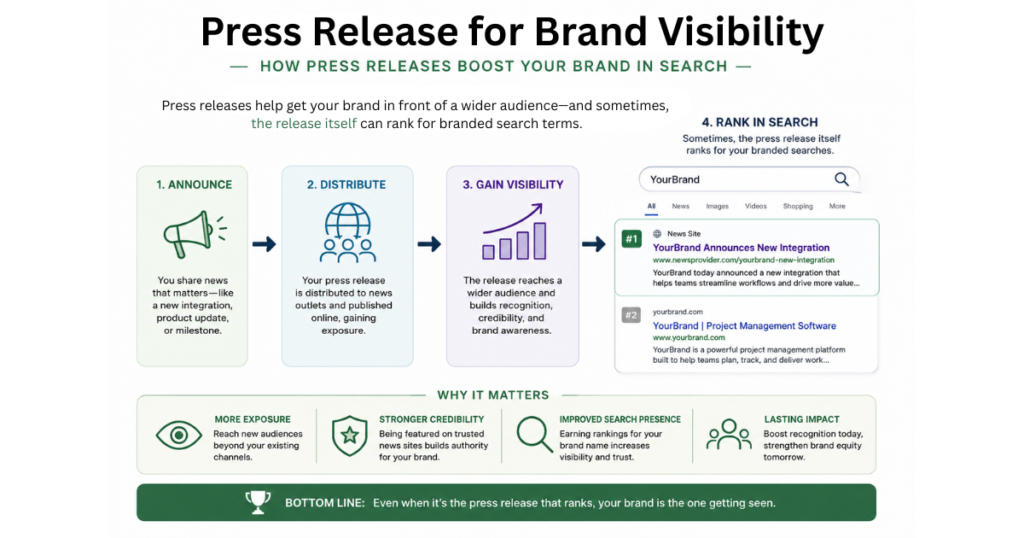
A well-written press release puts your brand in front of a wider audience, and sometimes the release itself ranks for branded search terms.
For example, a company like a mid-size project management SaaS tool might issue a release announcing a new integration, and see that release rank on the first page for searches of the company’s own name. Even when it’s the release itself ranking rather than the company’s homepage, it still reinforces visibility and recognition for the brand.
Building a Stronger Online Reputation
Consistent, well-timed releases build familiarity over time. The more people encounter a brand through legitimate news coverage, the more credible that brand starts to feel, which in turn makes people more likely to engage with and share what it puts out next.
A design tools startup that regularly issues product update releases, for instance, can end up dominating the top search results for its own brand name simply through consistent, quality output over time.
Earning Backlinks the Right Way
Backlinks shouldn’t be the primary goal of a press release, but they’re a realistic byproduct when the release is genuinely newsworthy and gets picked up by reputable outlets.
An AI writing tool that distributes a well-crafted release announcing a funding round or major feature launch, for example, might land coverage on a handful of industry publications, each linking back to the company’s site. Those are the links worth having, since they come from independent editorial decisions rather than paid placements.
Attracting Organic Mentions
Once visibility and reputation start compounding, journalists and bloggers are more likely to take notice on their own and give a story space without being pitched directly. Those unprompted mentions carry more SEO weight than a placement you paid for, since search engines read them as a genuine signal of relevance.
Expanding Overall Reach
Every share or mention sends a release further across the internet, into communities and networks a company might not have reached otherwise. That wider footprint compounds over time, making the brand a familiar name in more corners of its industry.
Supporting Local SEO
Including a business’s name, address, and phone number in a release helps anchor local search relevance, especially for service businesses trying to rank in a specific area. Every time that information gets cited elsewhere, it reinforces the business’s position on the local map and makes it easier for nearby customers to find.
Working In Relevant Keywords
Throughout all of this, keywords still matter, just not in a stuffed, unnatural way. Weaving in the terms your audience is actually searching for, without forcing them, makes sure the release resonates with real search intent rather than trying to trick a ranking algorithm.
How to Write a Press Release That’s Actually SEO-Friendly
Start With Something Genuinely Newsworthy
Every good release starts with news worth reading. A product launch, a milestone, a new partnership, anything that matters to your actual audience. If it’s not newsworthy, no amount of optimization will save it.
Write a Headline That Works for Both Readers and Search Engines
The headline is the first thing both people and search engines see. Work the primary keyword in naturally, spread relevant terms across the first 250 words and the meta description, and prioritize clarity over keyword density. A strong headline pulls double duty: it draws readers in and signals relevance to search engines at the same time.
Make It Skimmable
Most people skim rather than read online in full, so structure matters. Use the inverted pyramid approach, leading with the most important information and building out supporting detail afterward. Short paragraphs, subheadings, and bullet points make a release easier to scan, and images or video can add engagement without cluttering the core message. This helps both human readers and search engines parse the content.
Use Links Deliberately
Include a small number of links that genuinely add value, with descriptive anchor text rather than generic phrases like “click here.” Mark promotional or sponsored links as nofollow so search engines treat them correctly, and keep the overall link count low enough that the release doesn’t read as spammy.
Add Quotes That Say Something
A quote from a relevant person in the organization adds authority and a human element, but only if it adds insight rather than repeating what’s already been said. A quote that just restates the headline in different words isn’t earning its place.
Make It Easy to Follow Up
Always close with clear contact information, along with links to relevant pages on your site where readers can learn more. This helps journalists follow up and gives the release a natural path to drive traffic back to your site.
Proofread Before It Goes Out
Small errors undercut credibility fast. A clean, polished release signals professionalism, while typos or sloppy formatting can color how the whole announcement is received.
How to Distribute a Press Release
Writing a strong release only matters if it actually reaches people. A few distribution paths tend to work well together.
Distribution Services
A distribution service pushes your release out to a broad network of media outlets at once, increasing the odds of pickup without the time investment of individual outreach. Most services also include reporting so you can track performance and measure actual impact.
If you’d rather skip the manual side of this entirely, Scroll Craft Media offers press release distribution that handles both the writing and the placement.
Direct Outreach to Journalists and Bloggers
Reaching out directly to journalists who cover your space, with a personalized pitch explaining why the story matters to their audience, can lead to deeper coverage than a syndicated release ever will. One strong feature in a respected publication is often worth more than dozens of copies spread across smaller outlets.
Sharing on Owned Channels
Your own website, blog, and social profiles are still worth using. Sharing the release there reaches your existing audience directly and gives them an easy way to spread it further.
Email to Subscribers
An email list is already interested in what you have to say, so make sure they hear about major news first. A short summary with a link back to the full release can drive immediate traffic and encourage further sharing.
Repurposing Into Other Formats
A press release doesn’t have to stop being a press release. Turning key points into an infographic, a short video, or a longer blog post extends its reach into different audience segments and gives search engines more entry points to find and index the story.
Final Thoughts
A press release still has real SEO value in 2026, it just requires treating it like genuinely newsworthy content rather than a link-building shortcut. Get the writing right, distribute it deliberately, and the visibility, credibility, and backlinks tend to follow on their own.
Ready to put this into practice? Scroll Craft Media can help write and distribute a release built to do exactly this.
Related Blogs
What Is a Press Release? Definition, Benefits, and How to Write One
A press release is a formal way to share newsworthy stories with the public. See why they matter for businesses, reporters, and PR professionals.

How to Write a Press Release Step by Step
A practical breakdown of what a press release actually is, why brands still use them, and how to write and send one that gets picked up.